Software with 1/25th the Headcount
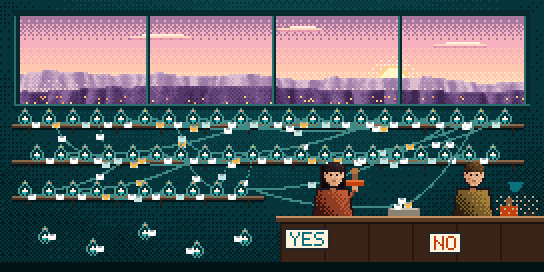
Blacksmith, the best-known company in our market, had about 40 people when it became a unicorn in October.
Sengi has two. My brother Clay and me.
You can’t charge one-sixth of GitHub’s price with a big payroll. You can with a small one and a lot of agents.
The other employees
Last month I wrote that a few people directing thousands of agents can beat a team of 500, if the people keep the decisions. This is what that looks like on a normal Thursday.
Here’s our agent network over the last 48 hours:
- 287 agent sessions on 7 machines.
- 1,503 times an agent picked up a piece of work.
- 225 new tasks filed, mostly by agents, for other agents.
- 748 progress notes and 549 messages.
- 39 decisions made by a person.
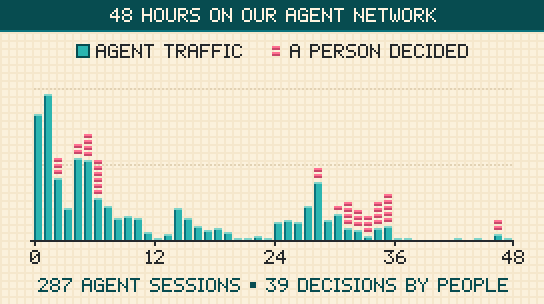
That last number is the one I like. Thousands of moves. And only thirty-nine calls that needed a human.
Ok thousands of moves. Really?
Here’s a sample of what agents worked on in those two days:
- Writing code. Speeding up slow pages, fixing tests, cleaning up old database tables.
- Fixing broken builds. When our main code breaks, an agent grabs it within seconds and starts on the fix.
- Running our machines. Spotting leftover files on a server and a queue that wouldn’t move.
- Marketing. Submitting Sengi to lists of GitHub Actions tools, answering Reddit threads that chatbots cite, reviewing the first week of our ads.
- Sales research. Finding companies whose builds are slow and expensive, and drafting emails I rewrite and send myself.
Each of those is a job where there’s always more to do than hands to do it. And each one can be checked.
What do you and Clay do?
Not much.
- Direction. What we build next, and what we don’t.
- Money. Prices, spending, anything that touches a customer’s bill. (with plenty of AI research input).
- Keys. Who and what can reach which systems.
- Anything hard to undo. Deleting data, changing a public price, saying something in public.
When an agent hits one of those, it writes up the choice, recommends an answer and waits. The question lands on my phone. I tap A or B. The answer goes on file with my name on it, so the next agent with the same question finds it. That’s the pattern from Don’t be a meat proxy, and the plumbing is in Agent mail, and who gets the last word.
One rule we never bend: a message between agents is information, not an order. An agent can ask another agent anything. It can’t smuggle a decision past a person by forwarding it.
Why it has to be this way
With two people, it’s easy to let the agents decide by default. There’s so much output, and most of it looks fine. That’s exactly how you waste billions of tokens on something you... um... didn’t know you were building.
For a company that runs other people’s code, the stakes are higher. Customers hand us their builds. Some of those builds touch passwords and keys. If small businesses are going to trust cheap computers, the trust has to be earned in how we run, not just in what we charge.
Intuit QuickBooks surveyed more than 34,000 small business owners for its 2026 AI Impact Report. The top worries “cluster around privacy and security, fear of errors, and uncertainty about what AI can do.” I read that as a product spec. Cheap isn’t enough. Cheap and verifiably secure is the product.
It’s not just us
Anthropic’s source control team, seven people, built a new version control system and code review tool in five months. Their conclusion: “Rapid development with a small team will become more common.”
Pete Koomen’s call for a cloud for small software points down the same road from the other end. Small teams building tools for themselves need somewhere simple and cheap to run them. That’s the bigger case in Microcompute for the rest of us.
--dangerously-skip-permissions
- Reading is the bottleneck. Agents produce more than two people can read. We choose what gets a careful look and what gets a glance. Sometimes we choose wrong.
- Saying no takes discipline. Building is cheap now, so everything looks worth building. Most ideas should wait.
- Security can become security theater. Thirty-nine decisions in two days is fine. Three hundred would technically mean more human oversight, but in reality means the agent requests are prone to be rubber stamped.
ELI15
In a company this small, the people at the top are also the people in the middle, and on the ground. When an agent brings forward a decision, the person reading it needs to understand it. While working on Barron’s Streetwise, Jack Hough told me he always writes his columns, and interview question to reflect one notch of understanding below what he thinks he knows already. “You’re always a bigger dummy than you think you are.” That’s why clay and I prompt agents to “ELI15” or write up the decision at hand with the context, and pros and cons of each choice explained as if we’re 15 year old. Not too different from financial journalism.
In short, two people with a clear idea can now run something real, and charge a lot less for it. Giants have venture funding. We have a group chat with a few hundred very diligent robots.
How we launched it is in $4,000 a month, no ads. More about me: about page.