Don’t be a meat proxy

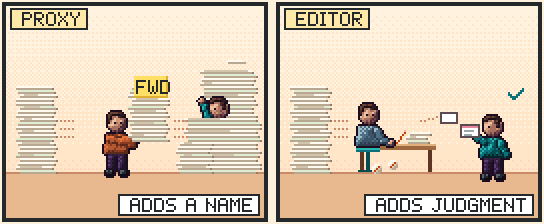
The engineer Niklas Gruhn coined the term “meat proxy” in a post in August 2026. It names something I think about a lot. The way I use it: a meat proxy is a person who sits between an AI and someone else and just passes things along. The model writes it, the person forwards it, and nobody in the middle reads it closely, judges it, or makes it shorter.
It’s an easy role to slide into. The output looks finished. It’s long, it’s confident, and it’s usually mostly right. Forwarding it feels like being helpful. But if all you add is your name, you’ve made the work worse: now there’s a person attached to something nobody actually checked, and the reader has to do the thinking you skipped.
More agents, more of this
The problem grows with the number of agents. One assistant writing one answer is manageable. Dozens of agents working in parallel produce reports, diffs, test results, plans and questions faster than anyone can read them in full.
Somebody has to turn all of that into something a person can act on. Not a summary of everything that happened, but a decision: here’s the choice, here are the options, here’s what I’d do and why, and here’s what it costs to wait. If that step doesn’t happen, one of two things follows. Either the decision maker drowns, or they stop reading and start approving. Both are bad.
What I learned at Barron’s
Before I worked on software, I was a producer and co-host of Barron’s Streetwise with Jack Hough. A lot of that job was translation. Finance is full of jargon that’s precise if you already know it and opaque if you don’t. My job was to take it and find the story underneath: what’s actually happening, why it matters, and what a listener should take away.
The skill wasn’t dumbing things down. Listeners were smart; they just weren’t specialists. The skill was knowing which details carried the meaning and which ones were there out of habit, and then saying it plainly without making it wrong.
That’s the same skill agent work needs now. The source material is different. Instead of earnings calls and analyst notes, it’s agent transcripts, pull requests and test logs. But the job is the same: read all of it, understand it, and bring back the part a person needs in order to decide.
Models used to talk over our heads
Early Claude models often talked over people’s heads. The answers were thorough and usually correct, and they were pitched at a reader who already knew most of what was being explained. Lots of hedges, lots of structure, the conclusion buried somewhere in the middle.
Models have gotten much better at this. But when you have many agents, each one being reasonably clear on its own doesn’t solve the problem. Ten clear reports are still ten reports. Turning them into one decision is still a person’s job, or at least a job a person has to own.
What a good handoff looks like
When I bring agent output to someone, I try to make it short enough to read in a minute:
- The decision. One sentence. What do you need from them?
- The options. Usually two or three, in plain words.
- My recommendation, and the reason for it.
- What happens if we wait, if that matters.
- Where the details are, for anyone who wants to check.
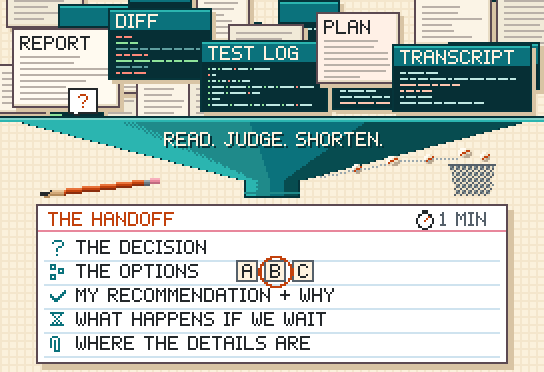
If I can’t write that, I don’t understand the work well enough yet, and forwarding it wouldn’t fix that.
This is also why I think the people have to keep the decisions, even on a small team running thousands of agents. A decision maker who is handed a clear choice can actually decide. One who’s handed a wall of output ends up deferring to it.
Agents can help with the translating. They can draft the summary, flag the disagreements between agents, and point at the risky change. Systems can be built so agents bring questions to a person instead of quietly guessing. But someone still has to read the draft, check it against what they know, and stand behind it. That’s the difference between a proxy and an editor.
I’d rather be the editor. More on how I work is on the about page.