Microcompute for the rest of us

The cloud is a marvel. It is also confusing as hell for small businesses.
Endless machines and a menu of 200 services is great if you’re a giant company full of platform engineers and AWS architects (and have a team whose whole job is reading the bill). If you’re a ten-person shop, you get the same slop.
My brother Clay and I think that’s about to change drastically.
Agents eat computers
Every time code changes, a computer has to build it and test it before anyone trusts it. That used to happen a few times a day. Now agents write code non-stop at a blistering pace.
GitHub’s Octoverse 2026 says developers now start more than 40% of pull requests with an agent. GitHub Actions, the service that runs those builds and tests, ran 124 million jobs a day this year. At Anthropic, Sachin Malhotra wrote that their testing volume grew 25x in six months.
Twenty-five times. In six months. Yuck.
Tara Tan at Strange Ventures said it plainly in August: “Coding agents are generating more code than existing infrastructure was built to handle.” Lenny Pruss at Amplify Partners went further. Testing, he wrote, “stops being a gate, and becomes a sandboxed multiverse.” Gergely Orosz has been tracking what the flood does to code review. Mitchell Hashimoto called it “the Gmail moment for version control.”
None of them were writing about small businesses. I’ll do that part.
Big software, small software
Pete Koomen put the problem best in Y Combinator’s Fall 2026 Requests for Startups. The big clouds “were designed for shipping Big Software that scales with many users… at the cost of complexity.” He wants “a cloud for small software.” Tools with one user, or a handful.
I’d stretch it one step. It’s not just the software that’s small. It’s the business. The accounting firm. The clinic. The co-op. The two brothers trying to commoditize actions runners...
David Heinemeier Hansson made the money case when his company left the cloud: “Of course it’s expensive to rent your computers from someone else.” He was talking about a company far bigger than ours. The math still travels.
Price, meet basement
So here’s our bet. Call it microcompute. Small, fast, cheap computers that a small team, or the agents working for one, can use without hiring a cloud whisperer. Priced near cost. Easy to leave.
We started with the most boring, most measurable slice we could find: the machines that build and test code. That’s Sengi. It runs GitHub Actions jobs from $0.001 a minute. GitHub charges $0.006 for the same size machine. That’s one-sixth the price, and the first 3,000 minutes a month are free.
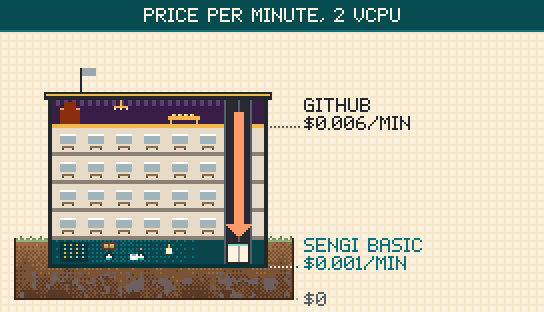
Boring is the point. Nobody needs convincing that tests matter. Agents are already mailing them the bill.
The goal is to commoditize the runner, which is the computer that runs those jobs. It should be like electricity. You use it, it works, you don’t think about who sells it.
Creative destruction, meet Communism for robots and nerds
The old way to fight a giant and disrupt an industry was to raise an army. Convince investors to give you $40 million. Hire 200 people, burn a few years, pray.
The new way is smaller. A few people who know exactly what they want. A lot of agents doing the volume. Shared tools instead of private empires. We run our whole company on an open-source agent network we built, called PeoplesCommune. The name is half a joke and half our actual plan. Communism doesn’t work for people (it’s been tried) - but it seems to work well for robots.
Small Software can be safe software
Small software also has to be safe software. Intuit QuickBooks asked more than 34,000 small business owners about AI for its 2026 AI Impact Report. Their answer: “The biggest barrier isn’t cost.” It’s privacy, security and fear of mistakes. Fair. Cheap and sketchy is still sketchy. So the agents working for a small business should be model-agnostic, run on computers it controls or rents cheap, plug into the tools it already uses, and leave the real calls to a person.
Runners are step one. Pooled compute for small businesses and their agents is the long game. We’ll earn it a minute at a time.
How the first month went is in $4,000 a month, no ads. How two people run it is in Software with 1/25th the Headcount. And why any of this should make software better, not just cheaper, is in Unslop software.
Fair warning: we sell the cheap computers. I’m biased. I’m also right.