Five levels of self-driving, for code

In February I went back on Barron’s Streetwise, the show I used to produce, to talk with Jack Hough about AI coding. To explain what had happened to me, I borrowed the levels of self-driving from cars and applied them to writing software. This is that framework, written down, and where I’d put us now.
First, where I started. About a year before that episode, I was hopeless at coding. I’d taken one programming class in college. I spent something like 120 hours on the final project, a Flappy Bird clone that didn’t work very well, and I barely passed.
Level 1: autocomplete
The first AI coding tools finished the line you were typing. For a working programmer, that’s a real time-saver. For me it was useless, because I didn’t know what the suggestions meant. You can’t accept or reject a suggestion you can’t read.
Level 2: describe it, get a front end
The first tool that changed things for me was Vercel’s v0, which turns a description into front-end code. At Dyrt we needed a dashboard for customers to see their food waste. The usual path was weeks of back-and-forth with a contract developer over what it should look like. With v0, as I put it on the show, “I was able to just whisper into this machine and it would come out with a result that was much closer to what I wanted.” If I wanted a tweak, it happened right away. Then the developer connected it to real data in about an hour.
That was the first time I could make the thing in my head show up on a screen without going through someone else.
Level 3: a chatbot in the editor
Next was Cursor: a chatbot inside a code editor. At this level you could build apps that actually worked, but you needed to know something about code to keep it honest. It never pushed back. It would never tell you that you were being an idiot, even when you were, and it happily built inefficient ideas exactly as described. It also wrote new code every time you asked, so you could end up with the same function written five different ways in five different places.
Level 3 rewards people who already know what good code looks like.
Level 4: describe the product, get the product
Around Christmas 2025 I started using Claude Code with Opus 4.5, and the ground moved. You could know very little about code, describe what you wanted, and conjure a working piece of software into existence, as long as the scope was small. I said on the show that you’d never have to look at the code. For small things, that was close to true.
Level 5: a town of agents
Level 5 is going from one agent to a team of them. For me that was Gas Town, Steve Yegge’s framework, which is themed after Mad Max. There’s a mayor who coordinates. There are polecats, worker agents that each build one feature. There’s a dog that wakes up polecats that have gone off track, and a witness that writes everything down. You give the town a plan and it works all night.
In February I said I couldn’t recommend it to most people, because running that many agents was expensive. And on the whole scale, I said we were at about a 4.1.
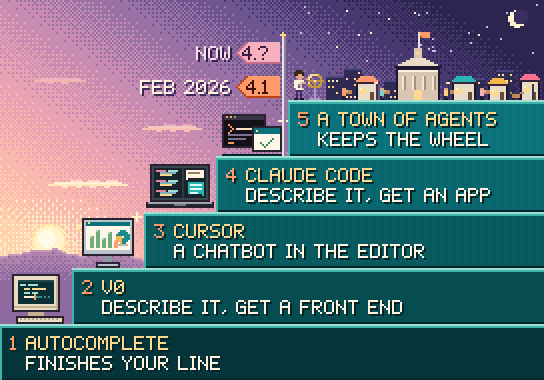
Where I’d put it now
Higher than 4.1. I won’t pretend to know the decimal.
A few things were already true in February and have only grown since. Claude Code had added agent teams two weeks before we recorded, and working with several agents at once has since stopped being an unusual setup. This site, which Jack poked at on the show, was already rebuilt with Gas Town, a reasonable test of whether someone who barely passed one coding class can ship software now. And my brother Clay and I now run our own agent mail across our machines.
But I’ve also changed my mind about what level 5 should mean. In a car, level 5 means no steering wheel. For software, I don’t want that. The town working all night is the easy part now. The hard part is the morning: someone has to read what it made, decide what’s right, and turn it into a decision a person can make. The more the agents can do, the more that part matters.
So my version of the top level keeps the wheel. The agents do the driving, and a few people keep the decisions. That’s the version I want to help teams build. There’s more about me on the about page, and Jack wrote about the conversation in his column, Vibe Coding in Gas Town.