$4,000 a month, no ads: launching Sengi

About a month after we launched Sengi, it was bringing in $4,000 a month. We spent nothing on ads. It’s growing more than 50% a month.
That’s not unicorn money. It’s two-brothers money, and that’s the point.
The why is in Microcompute for the rest of us. This is the how.
What we sell
Every time someone changes code, a computer builds it and tests it. On GitHub, that computer is rented by the minute. We rent you a cheaper one.
You change one line in a settings file. Your coding agent can do it for you. Then your builds run on our machines instead of GitHub’s.
- Basic costs $0.001 a minute. GitHub charges $0.006. That’s one-sixth, with 3,000 free minutes a month.
- Premium runs on bare-metal AMD Ryzen 9 machines. It’s about half GitHub’s price and nearly twice as fast. On the same real builds, a Premium run cost $0.069. GitHub’s cost $0.249.
That’s the whole product. It’s a utility bill. We just made it smaller.
Brothers in Blood, and Agentic Coding
We’ve done this before. At Dyrt, the composting company where I led product, Clay helped me build the tool that read our customers’ waste bills. Dyrt grew from 1,000 to 1.5 million pounds of food waste a month. Compost is a humbling first startup. Everything smells like a lesson.
Clay studied computational neuroscience at USC. He was in nursing school when he started coding with AI, back with GPT3 when most people still thought it was a party trick. Today he runs Sengi’s machines and platform as president and head of technology.
I studied neuroscience at Brown and then spent years in radio: public radio reporting, KCRW, audio at Finimize, producing Barron’s Streetwise. I came to code late. I wrote about that in Five levels of self-driving, for code.
We don’t have an org chart. We work together, and our agents talk to each other all day on our own agent network. More on that network in a future post.
A metric ton of agents
Across our repositories this year there are 22,175 commits. A commit is a saved change to the code. 68% of them carry an agent’s signature. In November it’s 86%, in reality it’s 99.99% (sometimes the agents save code under our names because they like to share the credit).
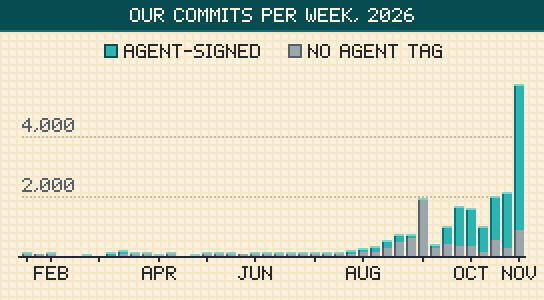
On September 10, the Sengi codebase took nearly 600 commits, around the clock.
Clay and I decide what to build. We read what comes back. We say no a lot. That’s the setup from A few people, a lot of agents: people keep the taste, agents bring the volume.
Three habits kept it from turning into soup:
- Small steps you can check. Every change gets built and tested before it lands. The tests never get tired. That’s also why we care so much about making them cheap.
- Decisions in writing. When an agent needs a call from us, it asks in writing, and the answer stays on file for the next agent. That’s Agent mail, and who gets the last word.
- Eat your own cooking. All the builds for jacks.med, our other company, run on Sengi. If something is slow, we feel it before a customer does.
No ads
We didn’t buy ads. Our first customers found us through chatbots.
People asked ChatGPT and friends how to make GitHub Actions cheaper or faster, and the answer named Sengi. That doesn’t happen by luck. Our site answers the questions people actually ask, in plain words, with real prices and the date we checked them. Chatbots like a straight answer. So do people.
This is where radio paid off. Working with agents is a lot like reporting. Ask good questions. Keep the loop tight. Cut until what’s left would make for an interesting dinner conversation with your uncle.
If you’re starting now
Pick a boring market that agents are already growing. We didn’t have to sell anyone on testing code. Their agents did that for us.
Compete on price, out loud. Publish your prices and theirs, with the date. If one plan is the cheap one and another is the fast one, say which is which.
Keep the decisions. It’s tempting to let agents ship whatever passes. Don’t. Speed without steering is just a faster crash. More in Software with 1/25th the Headcount.
Stay small on purpose. Two people and a lot of agents is a real company now. It doesn’t have to dress up as a big one.
What’s next
Runners first. Then cheap, pooled computing for small businesses and the agents that work for them.
If you run GitHub Actions on private code, try Sengi. If you’re building something like it, or think we’ve got it wrong, I’d love to hear from you. There’s more about me on the about page.